Showing posts with label Mistakes. Show all posts

Thursday, June 07, 2007

Mistake Number 12

I can't help feel that Bickham is a bit rigid in the way he states this rule. On the other hand, until a writer is comfortable with point of view, getting too tricky with it can lead to problems. So the message here is that the author should figure out whose story he's telling and keep it in that character's point of view, whether in first person or second person.

Now Bickham does allow that a story might have multiple points of view, although sometimes in a short story jumping around can make the piece seem disjointed.
"Changing viewpoint in a short story, where unity of effect is so crucial, usually makes the story seem disjointed. In a novel, there may be several viewpoints, but one must clearly dominate."
He even goes so far as to say that 70% of a novel should be in a single viewpoint. I'm sure not everyone agrees with this, but I believe I do (with important exceptions). And it is similar to advice I received in a workshop with Russell Banks. Both another writer and I had work with shifting points of view. Mine was a short story that went back and forth between the boy and girl in a young couple. The other writer was working on a novel about sisters and did the same thing. In both cases the suggestion was to decide whose story was being told and stick with that person's point of view. I revised my story to do that and I do think it is stronger for having done it.

#12 Don't Forget Whose Story It Is

Sunday, April 08, 2007

Mistake Number 11

Don't Forget Stimulus and Response. Things happen for a reason. People act for a reason. If they do something its because there was a stimulus; if there is a stimulus, there should be a reaction.
"The law of stimulus and response works at the nitty-gritty level of fiction, line to line, and it also works in melding larger parts of the story. For every effect, a cause. A domino does not fall for no immediate reason; it has to be nudged by the domino next to it."
True enough. But this has to be done carefully, because while necessary steps can't be left out, not all steps are necessary. Stimulus and Reaction, yes. Minute stage direction, no.

#11 Don't Forget Stimulus and Response

Thursday, March 08, 2007

Mistake Number 10

Don’t have things happen for no reason. This one resonates with me because coincidence, especially, disturbs a fictional experience.
“In real life, coincidence happens all the time. But in fiction—especially when the coincidence helps the character be at the right place at the right time, or overhear the crucial telephone conversation . . . coincidence is deadly.”
The same principle applies to motivation. People don’t do things without some goal or provocation in mind, and when they do behave that way in fiction it is less plausible, and therefore less satisfying. Background is one aspect of motivation, and needs to be portrayed logically.
“A great many stories tend to be unbelievable because the writer just shoved a character onstage to do something without thinking through how and why the character got there.”


#10 Don't Have Things Happen For No Reason

Tuesday, February 27, 2007

Mistake Number 9

Don't Duck Trouble. More good advice, and it bears some resemblance to advice I heard once from Charles Baxter: Make a Scene. By which he meant that as humans we tend to avoid confrontation. We choose the path of least resistance. We try to de-escalate an argument. But that's boring in fiction, and so Baxter says: let 'er rip. Avoid nothing. That's basically what Bickham is saying, I think: "In fiction, the best times for the writer--and the reader--are when the story's main character is in the worst trouble. Let your character relax, feel happy and content, and be worried about nothing, and your story dies. Pour on all sorts of woes so your poor character is thoroughly miserable and in the deepest kind of trouble, and your story perks right up--along with your reader's interest." And he's talking not about what he calls "adversity"--obstacles or forces in the character's way over which he has no control--which may be useful and create sympathy for the character. But he is talking about "conflict"--a "fight of some kind between people with opposing goals." Words to live by.

#9 Don't Duck Trouble

Sunday, February 04, 2007

Mistake Number 8

Don't Write About Wimps. I learned this one the hard way. My whole novel was about this passive guy--he even had a passive name, Peter, because he was intentionally passive--but it turned out that passive wasn't interesting to anyone but me. He has a new name now, and he's far less of a wimp, but whether he is active enough remains to be seen. (You'll have to read the book.) But Bickham is absolutely right about this.
"So, in most effective fiction, accidents don't determine the outcome. And your story people don't sit around passively. (Now and then you'll find a story in which what I've just said is disproven; but I'm talking about most successful fiction. Most readers don't want their stories to tell them life is random. They want to hear just the opposite. They want to believe something. What they want to believe is that trying hard can pay off, and that people are in charge of their own fate.) That's why wimps--spineless drifters who won't or can't rouse themselves to try--usually make terrible fiction characters."
Clear enough, and true.

#8 Don't Write About Wimps

Wednesday, January 24, 2007

Mistake Number 7

Don't Use Real People in Your Story. Fair enough. Real people are boring: “Good characters have to be constructed, not copied from actuality.” Here Bickham is telling us that the characters we build need to be larger than life in order to be vivid on the page. And "Good fiction characters also tend to be more understandable than real-life people. They do the things they do for motives that make more sense than real-life motives often do." The reader doesn't have to agree with those motives, but they have to be clear. "To put this point another way, in real life people often don't make sense. But in fiction, they do."

#7 Don't Use Real People in Your Story

Thursday, December 28, 2006

Mistake Number 6

Don't Describe Sunsets. By which Bickham is saying that too much pure description gets in the way of story, which should always be moving forward. Yup. This is clearly right, although clearly fine language doesn't always get in the way. It isn't to every reader's taste, but a fabulous passage describing setting can be a wonderful thing. Not pages and pages, true. And probably not sunsets in any case.

#6 Dont Describe Sunsets

Wednesday, December 13, 2006

Mistake Number 5

Bickham is getting serious with this one. What he calls “warming up the engines” I have also called “throat clearing.” I believe it is a useful tool in doing a first draft of a story—spelling out the background or the setting or the other static, backward looking details that ground the story—but that probably is not where the finished story is going to begin. The author clears his or her throat for a couple of pages, then gets to the real action of the story, or the “threat” or the “moment of change” as Bickham helpfully suggests:
“It is at this moment of crucial change, whatever it may be, that your story starts. Identify the moment of change, and you know when your story must open. To begin in any other way is to invite disaster.”
#5 Dont Warm Up Your Engines

Thursday, December 07, 2006

Mistake Number 4


I think it's safe to say I agree with this one--miracles are pretty unusual in the fiction writing business. Bickham says, "The writing of fiction--except in the case of that very rare genius--is a difficult job. It involves the interactive working of dozens of specific, hard-won techniques. It may become art, but only by first being consummate craft." Amen.

4. Don't Expect Miracles

Tuesday, November 28, 2006

Mistake Number 3


This one is debatable. I believe readers find a display of expertise to be convincing, adding to the author's credibility. But there has to be a reason for it. The best example Bickham cites is a paragraph filled with over-elevated language. That's not going make any reader happy. So, as a general rule, let's agree:

3. Don't Show Off When You Write.

Thursday, November 23, 2006

Mistake Number 2


2. Don't Consider Yourself Too Smart.

I certainly agree with this one. Bickham suggests posting a sign on your desk: NEVER WRITE DOWN TO YOUR READERS. Which is good advice. I tend to explain, and sometimes explain again, when usually the first time wasn't even necessary. The reader gets it, the reader enjoys connecting the dots . . . well, you get the idea. Ahem.

Monday, November 20, 2006

Mistake Number 1


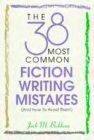
Awhile ago at the Green Valley Book Fair I picked up a copy (cheap) of Jack M. Bickham’s thin book The 38 Most Common Fiction Writing Mistakes (And How To Avoid Them) (Writers Digest Books, 1992). 38? Did he do a study? Was he going for 50 but got stuck? As odd as the title sounded, I’m a sucker for “How To” books when it comes to writing, so I bought it. And I’m finally getting around to reading it. And I will occasionally report back. Today is Mistake Number 1, but stay tuned for more.

1. Don’t Make Excuses.

That’s the first mistake, according to Bickham, although I assume that what is meant is that Making Excuses is the mistake, and not making excuses is how to avoid making excuses. That makes sense, no? “If you are serious about the craft of fiction, you must never make excuses for yourself. . . Consistent, persistent, even dogged work, day in and day out, is the professional’s way.” Good advice, not earth shattering.

Here’s where it gets interesting. Bickham suggests jotting down on a calendar the number of hourse spent writing each day and the number of pages produced that day. For days when there is no work to report, he commands that you type one double-spaced page of excuses, date it, and file it in a special place. The point here is that soon you’ll be so sick of making excuses that you’ll get down to the real business of writing. Okay, I’ll buy that. No excuses.