Thursday, March 31, 2011

The New Yorker: "Atria" by Ramona Ausubel

I didn’t care for this one much, and I think the reason for that is I don’t understand why Hazel does what she does. Okay, so her father died before she was born. So her mother used up her mothering skills on her other kids. So the sisters and mother were disappointed that Hazel wasn’t the reincarnation of her deceased father. Those don’t seem to be the worst things in the world, to me, so why does Hazel suddenly behave this way?

She’s in high school, doesn’t have a lot of friends. She’s looking forward to love one day but in no hurry. What she does for entertainment is walk, then come home and deal with her mother.
Her mother complains that Hazel is “such a teen-ager,” and wishes Hazel would skip ahead. So that’s what Hazel decides to do. (Again, is that sufficient motivation?) So with the skipping ahead in mind, she has casual sex with the 7-11 clerk, then she has sex with an older man (it’s rape, although she doesn’t resist).

And then she’s pregnant, and things are happening to her without her involvement. She imagines what it is that’s growing inside her—first a fur baby, then a large bird of prey, and eventually, when the baby is born, she thinks it’s a seal. Her mothers and sisters are there. The 7-11 clerk comes by to visit. But Hazel is in her own world.

And then the story takes a turn for the weird.

My bottom line is that I don’t buy Hazel’s actions. And that raises the question for me of how believable a character’s behavior has to be. I totally believe that someone could do what Hazel does, but this story, it seems to me, doesn’t prepare me for THIS character to do what Hazel does. The brief interview with Ramona Ausuble doesn't shed much light.

The story's title is interesting. "Atria" of course means a body cavity or chamber, including the chambers of the heart, and we can say that Hazel's heart is empty, but that her womb is filled. There are other gaps in her life, too, so the title is appropriate.

April 4, 2011: “Atria” by Ramona Ausubel

Write Hope: Benefit for Japan

Write Hope: About Write Hope

I'm surprised that I'm just now hearing about this, but Write Hope was formed by a bunch of writers to raise money for the victims of the Sendai earthquake in Japan. Take a look at what they're doing. Among other things, they're auctioning off some pretty great items.

Tuesday, March 29, 2011

Finalists announced for Man Booker International: Man Booker Prize news

Finalists announced for Man Booker International: Man Booker Prize news


The thirteen authors on the list are:
  • Wang Anyi (China)
  • Juan Goytisolo (Spain)
  • James Kelman (UK)
  • John le CarrĂ© (UK)
  • Amin Maalouf (Lebanon)
  • David Malouf (Australia)
  • Dacia Maraini (Italy)
  • Rohinton Mistry (India/Canada)
  • Philip Pullman (UK)
  • Marilynne Robinson (USA)
  • Philip Roth (USA)
  • Su Tong (China)
  • Anne Tyler (USA)

Sunday, March 27, 2011

Bracketology

By this point in March Madness, I've usually lost interest. After all, my team, Northwestern, has NEVER been to the NCAA tournament. (They've been to the NIT three years in a row and made it to the quarterfinals this year, but that dream ended last week.) And while Indiana used to be a regular in the Sweet 16, that seems like ancient history, and the recent Hoosier teams have been terrible.

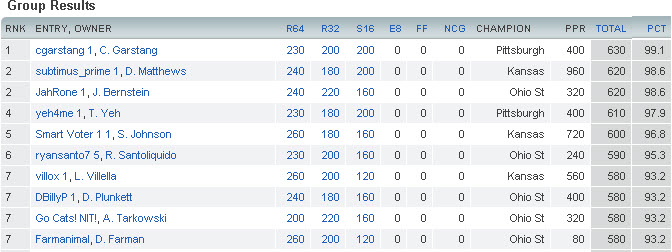
But this year, I'm interested. I submitted a bracket on ESPN.com as part of a group. ESPN received 5.6 million brackets, which is mind-blowing. My group, made up of readers of a Northwestern University Sports Blog called Lake the Posts, has 150 people in it, and the reason I'm interested is that somehow, someway, I'm currently #1 in the group. Hard to believe. The main reason I'm there at this point, I think, is that few people picked Kentucky to beat Ohio State, but I did--mostly as an anti-OSU move.

Will I still be in the lead at the end? Doubtful, because I picked Pitt to win the tourney and they were upset by Butler. But it's still possible. Here's what I need to have happen:

1. VCU beats Kansas today. I actually picked Kansas to make the final four, so I would maximize my points with a KU victory, but that will open to the door to entries that picked Kansas to win it all, and I can't have that. Go VCU! It's a long shot, but VCU has won other games they weren't supposed to win, so they can do this.

2. Kentucky beats UNC today. UNC has been looking good, so that's going to be tough hurdle. And it's not like I'm a Kentucky fan. If not for the brackets, I'd root for both teams to lose this game.

3. Then, next weekend in the semis, Uconn beats Kentucky. I originally had picked Uconn to lose to Pitt in the Championship game, so I still need for them to make the final.

4. And VCU has to beat Butler. Having grown up a few blocks from Butler's campus, I'll certainly be rooting for Butler if they're playing anyone other than VCU, since my bracket will be dead at this point. But there's someone who picked them to win the tournament, so my entry needs them to lose at this point.

5. In the final VCU beats Uconn.

If all that happens, I win!

As I said, doubtful. But still. It's a reason to care about the games. Go VCU!

Friday, March 25, 2011

The Impact of my Kindle on my Book Buying Habit

I bought a Kindle a couple of months ago. Part of my thinking was that I would read newspapers and magazines on it, and that would save paper, solve storage issues, etc. That's worked nicely, although I dropped my NYT subscription after the trial period because I didn't want to pay $19.95 a month. I'm thrilled with the New Yorker for Kindle, not least because it arrives on my Kindle at the earliest possible moment--the Monday one week BEFORE its cover date.

But I also Kindled up because I have too many books (a huge antilibrary) and had run out of room. I knew I wouldn't limit my book-buying solely to electronic books--among other things, there are many books that appeal to me that aren't on Kindle yet--but if there was something I wanted to read immediately I could get it right away and not worry about shelf space.

Except, for the most part, I haven't bought a lot of Kindle books. I've downloaded lots of free books. And I've bought a couple. I got one the other day by a friend because I was keen to get it, even though I know it will be a little while before I read it (simply because I have some book review deadlines). Price is a factor. One friend's book came out recently in original trade paper. Amazon sells the physical book for under $9 (a 40% discount off the cover price) but the Kindle price is $9.99. I simply don't understand that. So I haven't bought the book yet, I'm sorry to say, and I'm not sure I will until I'm absolutely ready to read it.

Which brings me to the real point of this post. I have all my life collected books. I like owning them. I like their potential. But I also like looking at them and knowing they are physically there. Since the house is full of them, I don't need any more books to feed that acquisitiveness, but hoarding books on the Kindle isn't going to give me the same satisfaction. Yes, I'm downloading free classics, but that's in part so I can box up the hard copies on my shelves. I'm no longer the book slut I was.

Unless they're free. I recently moderated two panels at the Virginia Festival of the Book. The actual moderation during the session was fun and easy, but one is supposed to prepare, and I was given a stack of books to read. I did (um, mostly; didn't make it all the way through one of them). And now I have to find some place to put all those books!

Too bad they didn't give me the Kindle editions . . .

By the way, one of the books on my Kindle is my own, and I have to say it looks great, and it's a bargain at $3.99. You can buy it here: In an Uncharted Country on Kindle. Just sayin'.

Wednesday, March 23, 2011

The New Yorker: "U.F.O. in Kushiro" by Haruki Murakami

This story is only available to subscribers, but then it’s a re-run from 10 years ago. The story carries a note from the editors: “This story, which was inspired by the 1995 earthquake in Kobe, Japan, was originally published in The New Yorker’s March 19, 2001 issue.”

It’s a good story, and not nearly as disturbing as I thought it would be after reading that note. Because the quake of the story is really just backdrop, which may be all it really could be.

But the story deals with Komura, an electronics salesman in Tokyo, whose wife is obsessed with watching news of a recent major earthquake. Their relationship is not filled with warmth, although Komura is happy enough. But a week after the quake she has left him, gone home to the inn her parents run in the north. He’s shocked by this, and decides to take some time off from work to figure out what to do. A colleague makes a strange offer—if Komura will carry a package with him to Hokkaido, the colleague will pay his way. There’s no reason not to, so Komura agrees.

When he gets to his destination, Kushiro, Komura hands over the package to his friend’s sister and woman she has brought along. They go to a noodle shop, talk briefly about Komura’s wife—the girls were under the impression that she’s dead. “No matter how far you travel, you can never get away from yourself,” Komura says, echoing what the sister’s friend has said. “It’s like your shadow. It follows you everywhere.” They speculate as to how the wife’s leaving is connected to the earthquake, and compare it to a disappearance that occurred after a local woman saw a UFO.

The hotel they take him to is a “love hotel” but he thinks nothing of that. They talk and drink beer. The sister leaves. Komura tries to make love to the woman but can’t.

It is then that he makes the connection between the package that he carried from Tokyo and the excuse his wife gave for leaving him. The woman says of the reason he’s wondering now about what was in the package: “It’s because that box contains the something that was inside you. You didn’t know that when you carried it here and gave it to Keiko with your own hands. Now you’ll never get it back.” She claims she’s joking, but since there was nothing inside him and nothing in the package, it seems as if he’s now free to begin again.

Terrific story. Whether any of this is the least bit comforting to those affected by the Sendai earthquake is another matter. I doubt it.

March 28, 2011: “U.F.O. in Kushiro” by Haruki Murakami

Tuesday, March 22, 2011

Reviews of In an Uncharted Country

It's been about a year and a half since my book, In an Uncharted Country (Press 53), came out. I've been pleased with the reaction of readers and reviewers, although it doesn't seem as though there have been a whole lot of either! But the book is still available (you can order it from any bookstore, and many stores in my area stock it), and of course you can buy it on Amazon.com (both paperback and Kindle), Barnes & Noble, and your local independent booksellers.

The book has even won some awards, I'm happy to say. It received a Gold Medal ("Ippy") from Independent Publisher for Best Fiction in the Mid-Atlantic, and it also won the Maria Thomas Fiction Award from Peace Corps Writers.

And the reviews have been quite good. There was the review by Janelle Adsit in Mid-American Review. There was the review by Mark Brazaitis in Peace Corps Writers. The book earned a brief mention in the Richmond Times Dispatch. Diane Becker wrote a very nice review in The Short Review. And there was another nice review in the Virginia-Pilot. There have also been a smattering of reviews on various blogs and websites.

I like to give readings from the book, and I've had some very fun appearances, but visiting book clubs has been the best experience of all, I think. I'm not spending as much time on promotion of this book as I once was, but I'm still available for readings, book clubs, seminars and workshops.

Sunday, March 20, 2011

Virginia Festival of the Book--Friday and Saturday

The Virginia Festival of the Book continued on Friday, and all of the programs I went to were great.

First, I headed over to WriterHouse for the Novels About Novelists panel, which featured Martha McPhee, John McNally, and Carolyn Parkhurst. I think I would enjoy all three of those novels, and all three writers were very good presenters. I didn't buy the books, but I'm definitely going to keep them in mind.

Then I walked back to New Dominion Bookshop, stopping on the way for coffee at Java Java, thinking I had plenty of time. And yet I realized the next program I wanted to see would be in high demand, so I finished quickly and got to the store. Where the seats were already filled. But I sat on the stairs and that was fine. This was the National Book Award Winners panel, featuring John Casey, Kathryn Erskine, and Jaimy Gordon. I was able to chat with John a bit--I know him from the Sewanee Writers' Conference--and got both Kathryn's and Jaimy's books. (I already had John's.)

After that program I had a little time to walk around the mall before my next program, also at New Dominion. This one was poetry, and while the space wasn't as crowded as it had been for the NBA winners, it was pretty full. The subject was The Disastrous Muse and featured Dan Albergotti, Jake Adam York, and Jon Pineda, all of whom I knew, and Jane Satterfield, whom I'd heard of but never met. The readings were all great. Then it was time to hurry home.

On Saturday I came over the mountain earlier because I was moderating a panel at 10AM. First, in the bookfair, I saw people I knew from both WriterHouse and James River Writers, so I chatted with them for a while. The panel went well, I thought. The subject was "Death: Another Time, Another Place" and, although I still don't know exactly how that title covered all the books represented on the panel, we had plenty to talk about. I really enjoyed listening to John Connolly, Alan Orloff, Deanna Raybourn, and Paul Robertson talk about their work. There were some very good questions, and then it was over. (The book signing afterward was a little confusing. Fans were supposed to go all the way out to the lobby to buy the books and then come back to the signing area, which was in the hallway. That wasn't made clear to me as a moderator or else I would have announced it. Also, my book was available for sale, but I doubt that anyone bought it--I wasn't able to stick around to sign, even if there had been a space for me.)

I hurried out to Barnes & Noble for the Short Story panel, the one I was on last year, and discovered that the moderator this year was the same as last year's also. I probably would have gone to this program even if my friend Mary Akers hadn't been on it, but it was fun to hear her read again. Also on the panel were Ed Falco and Andrew Wingfield, whose books I bought (I already had Mary's, of course), and Ariel Sabar, whose memoir I bought when he appeared at the Festival two years ago.

After a late lunch, then, I came back to Barnes & Noble to moderate my last panel, on Historical Fiction. We had a good crowd--better than I expected for late on a Saturday afternoon--for Lenore Hart, Brenda Rickman Vantrease, George Robert Minkoff, and Paul Robertson. Unfortunately I let their presentations go on a little long so there was only about 15 minutes for questions. It was all fascinating.

And then there was just enough time to head back to the mall for the authors' reception at the Paramount, a fun event that I always enjoy.

A very successful Festival! (It continues today, but I wasn't drawn to the events on the schedule for today.)

Friday, March 18, 2011

Virginia Festival of the Book

I missed opening day of the Virginia Festival of the Book, but I did get over there yesterday for a couple of programs. First, I went to Narratives of Illness at New Dominion Bookshop, because it featured Sarah Collins Honenberger and Leora Skolkin-Smith, both of whom I know, Elizabeth McColl, and Caroline Leavitt. It was great to hear each of them describe her book, and it also gave me some great ideas!

I wasn't sure I wanted to drive out to Barnes & Noble for the next event on my list, but I did. It was called Parallel Lives, for reasons that still aren't clear to me, but it featured Susan Gregg Gilmore, Michele Young-Stone, and Alden Bigelow. Each gave a short reading and answered questions. I also saw a bunch of people I knew at the event.

There was more after that I would like to have stayed for, but I had to head back over the mountain . . . I'll get back to the festival for several events today.

Wednesday, March 16, 2011

The New Yorker: "Rollingwood" by Ben Marcus


Ben Marcus has a new novel coming out next year, The Flame Alphabet, but from what I’ve read about that book, this story doesn’t seem to be an excerpt. Which is good. Because I liked it a lot, in a horrified, angry sort of way. Sorry it’s not available online to non-subscribers. It’s a really good read.

The point of view character is Mather. (Surely it’s not accidental that ‘Mather’ is a combination of Mother and Father, given how the story unfolds.) He shares custody of Alan, an asthmatic 18-month-old kid, with the boy’s mother, Maureen. The reader doesn’t even meet Maureen until well into the story, when Mather has gone to her apartment for the “handoff” of Alan. Single-parenthood with a kid like Alan seems especially tough. He needs a special humidifier. Alan doesn’t have a car so he has to take Alan in his carpool to his workplace where Alan spends the day in the nursery. Except when the carpool doesn’t show up and Mather has to take Alan on the bus. Except when the nursery is inexplicably closed and Mather has to take a personal day off in order to take care of his son.

When we first meet the mother, she asks Mather to keep Alan for a while because she and her boyfriend are going off on a trip. Off they go, and Mather doesn’t complain, because he doesn’t want to be the kind of guy who complains. But Maureen doesn’t come back, and doesn’t call, and the nursery is closed, and Mather doesn’t know what to do. Meanwhile, he’s having problems at work—some temps are using his cubicle, and his boss speaks in riddles. (The writing is clearly on the wall, but Mather doesn’t see it.) During a crucial conversation with the boss, the baby sitter calls but Mather doesn’t understand what she’s saying, so he leaves work, takes the bus home, and finds that Maureen and her boyfriend are taking Alan away, and Maureen is furious at Mather for leaving Alan alone “with a stranger.”

It’s all so unfair, and the reader expects Mather to explode in rage. (And he does, briefly, at one of Maureen’s friends, whom he’s called to find out where the hell she is.) But he just takes it.

The story, told in the present tense, is fast-paced, and although it’s long—especially compared to last week’s story—it moves quickly. The title is surely significant. Mather gazes longingly at the neighborhood where he grew up, Rollingwood, and compares it to the treeless area where he now lives. In Rollingwood, it is always 3:15 because the school's clocktower broke years ago, so school is always out. A kid's idea of a perfect place to live. But that's not where he lives now, it's not where Alan will grow up, and he realizes that, in fact, he'll have little say over where Alan goes to school. It's all terribly depressing. But Mather has no choice but to go on this way, and so he goes home an prepares for Alan's next visit.

March 21, 2001: “Rollingwood” by Ben Marcus

Helen Schulman Shares Novel-Writing Tips From Cynthia Ozick to Jennifer Egan | Word Craft - WSJ.com

Helen Schulman Shares Novel-Writing Tips From Cynthia Ozick to Jennifer Egan | Word Craft - WSJ.com

Here's a snippet:


Starting from page one is an idea I stole from the novelist Elizabeth Dewberry. When she told me that beginning from the beginning was how she commenced every day, I thought I'd give it a try. That was two decades ago.Since then, many things have changed about the way I write. I used to write at night (now I sleep), spend all day writing (now I'm lucky to get a few solid hours in the morning), and smoke (no more). But I still move glacially forward every day that I sit down at my computer, rethinking and refining each paragraph, line, and word as I go along.

Sunday, March 13, 2011

The New Yorker: "Going for a Beer" by Robert Coover


I may be referring to this story for years to come for the brilliant way time passes in every sentence. The point of view character can barely conceive of an action before he’s already completed it:
“He finds himself sitting in the neighborhood bar drinking a beer at about the same time that he began to think about going there for one. In fact, he has finished it. Perhaps he’ll have a second one, he thinks, as he downs it and asks for a third.”
And on it goes, through picking up a woman, having sex, dating, marrying, having children, having an affair, divorce, commiserating with his ex-wife’s new husband, being visited on his deathbed by his son, death.

Breathless: Life is short.

March 14, 2011: “Going for a Beer” by Robert Coover

Prime Number Magazine updated today, 3/13/11

It's national prime number day and we've posted our lasted update (#5.5) to Prime Number Magazine, with work by Steve Mitchell, Meg Tuite, M.V. Montgomery, Dan Alter, Kristine Ong Muslim, Rimas Uzgiris, and Nicholas Wong.

We're open for submissions! (We especially need flash fiction non-fiction at the moment, but we're reading in all genres.)

Saturday, March 12, 2011

SWAG WriterDay - March

SWAG -- the Staunton, Waynesboro, Augusta Group of Writers -- has been holding monthly WriterDay happy hour celebrations for the past few months, on the Second Wednesday of each month, from 6-8pm.

This picture is from our March get together.

Up to know, the gathering has been simply talking about writing and publishing, sharing ideas and tips, and general networking. Starting in April, though, SWAG will combine the happy hour with an open mic night (or open no-mic, since at least initially will be un-amplified). For that event we'll move to the newly reopened Darjeeling Café at 103 W. Beverley. We'll convene at 6 and the readings will commence at 7.

Hope you can join us!

Monday, March 07, 2011

Why Do Writers Abandon Novels? - NYTimes.com

Why Do Writers Abandon Novels? - NYTimes.com

On my Facebook page we're having a discussion about this topic, and for most of us it isn't an academic question. Most writers I know have some abandoned work in a drawer, or a filing cabinet, or tucked away in a computer folder somewhere. I certainly do. My MFA thesis was a novel, which then became two novels when I split it apart, and now both of them languish. I've just finished another novel that may or may not ever see the light of day. But I find it extremely difficult to let go of this work, partly because I spent so much time on these projects and partly because I still believe in them.

When writers say that they've given up on a book because it isn't "working" I simply do not know what they mean. Apparently others do understand this concept, but no one has articulated it for me in a way that I find fully convincing. Can't everything be fixed? Your main character isn't sufficiently [fill in the blank: likable, sympathetic, engaging, interesting]. So change him! The plot isn't sufficiently [fill in the blank: believable, engaging, dynamic]. So tighten the plot or add the elements it's lacking.

Unless of course you've simply lost interest in these characters or the plot and decide that you want to move on to something else. But that's a different question. That's giving up on the project; it isn't a judgment that it isn't "working," whatever that means.

I like this mention from the article of Updike's work:
Many writers get lost in their first attempt at a longer work. Adam Begley, author of a forthcoming biography, said Updike wrote two-thirds of “Willow,” a small-town novel, while still a student at Harvard. Loath to waste either ideas or paper, Updike mined the novel for material for a series of Willow-set stories — some of which were written on the flip side of old novel pages.
This is now what I'm trying to do with the early novels--I'm mining them for stories (which isn't as easy as I'd hoped it would be). I still think that original novel is a good idea, but it would have to be completely rewritten. I'm a better writer now than I was when I started that project, so I think I could do it. I just don't want to. I've [mostly] moved on.


Is the novel in your drawer one that isn't working? Or is it one that you've simply lost the will to work on?

The Northville Review | In Hoan Kiem Lake

I'm very happy that my story "In Hoan Kiem Lake" is now live at The Northville Review. This story is part of a series of mostly very short pieces about a guy named Oliver.

The Northville Review | In Hoan Kiem Lake

Thursday, March 03, 2011

The New Yorker: "Backbone" by David Foster Wallace

This New Yorker story is available for free, folks, so have at it. It’s more brilliance from David Foster Wallace. That’s the good news. The bad news is that it must be an excerpt from his posthumous novel, coming out next month. I don’t know that for sure, but this “story” doesn't end, it only stops, and so I assume it is excerpted from something.

But, as I say, it’s brilliant. The story is about a kid who gets it into his head that he wants to kiss every inch of his body. To do so, he has to become something of a contortionist, and he develops this skill gradually. Reading how he does this is where Wallace is at his best.

The kid’s not the only contortionist in the family, however. His father is having multiple affairs, rationalizing each of them, twisting his logic in much the same way that his son is twisting his body.

Along the way, Wallace discourses on pain and the tolerance thereof:

In fact, patients who are critically ill or gravely injured do not necessarily experience intense pain. Nor is the observed intensity of pain directly proportional to the extent or severity of the damage; the correlation depends also on whether the “pain pathways” of the anterolateral spinothalamic system are intact and functioning within established norms. In addition, the personality of a neurotic patient may accentuate felt pain, and a stoic or resilient personality may diminish its perceived intensity.


Eventually, the boy has only his own head to conquer, but he’s confident he can do it.

March 7, 2011: “Backbone” by David Foster Wallace