All in all, 2011 turned out to be a pretty good year. It didn't begin with much promise. My agent had still not managed to sell my novel in stories, and I was struggling with the manuscript of a new novel, unsure of what would become of it. I was studying French (that was fun, at least), but was turned down for a residency in France. I was working hard, but nothing seemed to be going right.
But then . . .
The AWP conference was in March in DC. I was on two panels, saw a lot of friends, and spent a lot of time in the bookfair. I was energized, as I usually am, and full of ideas.
In May I attended the 10th Anniversary Celebration of the Queens University of Charlotte MFA Program, and also participated in the alumni workshop in which the beginning of my novel was critiqued by peers and by an editor from a major publisher. That experience was encouraging--the feedback was quite positive--and I pushed ahead with the book.
In June I attended the Tinker Mountain Writers Workshop at Hollins College. I did it in part because several friends had plans to go to various workshops around the country and I suddenly felt left out, but also because Fred Leebron was teaching an advanced novel writing class and I felt that was what I needed. It was great. I got more good feedback and encouragement about the novel.
In July I went to Korea. This had been planned for some time. The government of South Korea has been sponsoring re-visits for Returned Peace Corps Volunteers who served there, organized by the RPCV group Friends of Korea. I hadn't managed to get one of the earlier trips, so this was my time. Plus, the novel I was working on was partly set in Korea, and it seemed a good opportunity to refresh my sense memory. It was a fun trip. I didn't get any writing done while I was there, but had a great time.
Around this time, I got some good publishing news. Although my agent had not been able to sell my novel in stories, I had submitted it to a few small presses on my own (with my agent's blessing), and finally got an offer to publish it. Since I knew the publisher--Press 53 also published my first book, In an Uncharted Country--I felt very good about that. In addition, a number of the stories from the novel in stories were accepted by good magazines, which made me very happy, too. The book, WHAT THE ZHANG BOYS KNOW, will be published in September 2012.
And then I found out that I got the residency in France after all. So, in mid-August, I went to the South of France for three weeks, the first of which was being a tourist in Toulouse. During the last two weeks, spent at VCCA France in Auvillar, I completed the revisions on my novel. (I posted a lot of pictures from that trip, as well as the earlier Korea trip, here on Perpetual Folly.) Just before I began that trip, my agent and I parted ways, so I knew that I would be looking for a new agent when I got home in September.
In September, then, with a completed novel in hand, I began the search. Having done that three times before--without success for my MFA Thesis novel and also for my story collection, and then for my novel in stories--I knew what a hard and frustrating process that could be. But something was different this time. Lower expectations? Timing? A better query letter? A better novel? Whatever was different, by the end of the month I had signed with a new agent.
In October I worked at placing more of the stories from the WHAT THE ZHANG BOYS KNOW (there are only 3 left at this point) and also did research and outlining for a new novel.
In November I participated in Nanowrimo, simply as a way to get a lot of words for the new novel on paper, to see if the structure worked. But I also had a 2-week residency at VCCA in Amherst, Virginia, and so was able to get most of a first, very rough, pre-draft of the novel done.
And in December I continued work on that novel and some other projects, as well as finalizing Issue No. 17 of Prime Number Magzine (our 7th issue), which comes out in January. Also in December, a couple of stories appeared in some fine online magazines, and another story acceptance came in.
Which brings us to now, the New Year. I realize that 2011 was actually a very good year, and I'm grateful, but also looking forward to more good things in 2012.
Like a dog that returns to his vomit is a fool that repeats his folly. Proverbs 26:11
Showing posts with label Korea. Show all posts
Monday, January 02, 2012
It was a very good year.
Labels:
AWP,
Korea,
Peace Corps,
Tinker Mountain,
VCCA,
VCCA France
Saturday, November 19, 2011
Book Review: Dispatches from the Peninsula by Chris Tharp
Chris Tharp
Signal 8 Press, 2011
I arrived in Seoul, South Korea, in early January, 1976,
half a year after graduating from college. To say that I didn’t know what I was
getting myself into would be an enormous understatement. But, to a large
degree, that was the point. I had joined the Peace Corps—taking a leave from
the graduate school program that was, at best, a feeble attempt to forestall
real life. Like most Peace Corps Volunteers, I had mixed motives in signing up:
I wanted to help people, sure; but I also wanted an adventure. I also didn’t
know what I wanted to be when I grew up, and I was buying time.
So we landed on a frigid morning, a group of twenty-five or
so volunteers destined to work in “Higher Education English,” meaning that we
would be teaching English as a Second Language to college students, most of
whom were enrolled in English Education programs in their universities and
colleges. Like my fellow volunteers, I knew no Korean, knew little about Korea,
and had no teaching experience. Peace Corps remedied that with two months of
intensive training—a full morning of Korean language studies in small groups
(not to mention the language learning that occurred in the family homes that
hosted us), and afternoons of lessons in both Korean culture and history and
the rudiments of Teaching English to Speakers of Other Languages (TESOL). By
the end of training, we were ready to head to our duty stations, in my case a
provincial capital a hundred miles or so south of Seoul, into situations where
there were no other foreigners and where English-speakers were few.
While the experience was not uniformly positive, those two
years of Peace Corps service were extraordinary, and have shaped just about
everything I have done since. They taught me about poverty, since Korea in the ´70s
was still a very poor country. They taught me to cope with hardship. They also
instilled me with an indelible fondness for Korea, and in the 35 years since I
completed my service I have been back many times for business and pleasure, including a wonderful trip
earlier this year with other former Peace Corps Volunteers.
So I was pleased when the opportunity came up recently to
review Dispatches from the Peninsula: Six
Years in South Korea by an American English teacher in Korea. I relished
the chance to share another American’s experience in Korea, updated by three
decades. And for the most part I wasn’t disappointed. The writing is excellent,
and the conversational tone is just right for this sort of memoir/travelogue. Plus,
author Chris Tharp, as far as I can tell, gets the important stuff right—his
digressions into Korean culture and history, his comments on contemporary
politics and society, even his understanding of the Korean view of their
country’s place in the world today, seem to me to be spot on, and are probably
enlightening to readers who don’t know the country. It’s a fun read.
If there is disappointment here, it stems from the author’s
limited experience in the country. Yes, he’s lived there six years, but he
seems to have spent it almost entirely in Pusan (hanging out with other expats),
with only brief forays into the surrounding countryside. His time spent with
Koreans outside of the classroom seems to be confined to drinking sessions (or
over-drinking sessions), which he seems to believe is the national pastime, and
a succession of girlfriends. And there are omissions that I think might have
presented a more complete picture of life in the Land of Morning Calm. Tharp says
he doesn’t like visiting Buddhist Temples, but Buddhism has had an important
impact on Korea, as have both animist religions and Christianity, both
mentioned only in passing. Tharp addresses anti-Americanism but doesn’t discuss
the role that the stationing of 30,000 American troops (42,000 when I lived
there) on the peninsula has played in that sentiment. (In fairness, he does
mention one incident involving an American soldier that inflamed public opinion,
but the tensions run much deeper.) And while Tharp does talk about some
regional rivalries in Korea, he doesn’t mention that these rivalries have their
roots in the warring kingdoms that arose two thousand years ago, which also
helps to put the separation of North and South Korea in context.
Tharp is part of what we might call the Anti-Peace Corps,
the cadre of young native-English speakers drawn from all over the world who have
descended on Korea to fill the demand for English teachers. In the ´70s, the
Peace Corps met some of that demand at very little cost to the Koreans. But the
Peace Corps left Korea in the ´80s—after the country reached middle-income status—and
now the country can afford to hire people to come teach. Unlike Peace Corps
Volunteers, these teachers generally receive no training—not in teaching
techniques, not in Korean culture, and not in Korean language. With little
preparation in cultural sensitivity, it is no surprise when these foreigners
clash with their hosts, such as the numerous incidents Tharp recounts in Dispatches.
But I don’t mean to be overly harsh, and I readily admit
that some of my criticism is the result of my nostalgia for a Korea that is
these days hard to find. In fact, I enjoyed Dispatches
very much, and appreciated Tharp’s growth over the period described in the
book. In the sections covering his early days in the country, Tharp is condescending
toward Koreans (in the tradition of Paul Theroux—a former Peace Corps Volunteer—who
never met a local he couldn’t make fun of). But over time, it’s clear that
Tharp’s affection for Korea and his understanding of the country have grown, so
that in the later sections of the book the self-portrait is of a man who is
much more in tune with his surroundings. I also was touched by Tharp’s account
of the loss of both his mother and father while living abroad (which closely
paralleled the deaths of both of my parents while I lived in Singapore in the
´80s and early ´90s), and the challenges of being so distant from family. I
also could relate to Tharp’s experience in other ways, including his love of
Korean food and his struggles with the Korean language.
If you’re considering teaching English abroad, of if you’re
just interested in what life is like for a foreigner in Korea, read this book.
Labels:
book review,
Chris Tharp,
Expat Life,
Korea,
Signal 8
Friday, July 15, 2011
Days 9 & 10 -- Seoul (The End)
Friday was our last full day of the Korea trip. The morning's activity occurred at the Seoul History Museum, where we had musical and dramatic performances by youth volunteers (mostly precocious 12 year olds). We also had a buffet lunch (ribs!) and then free time in the afternoon. Which would have been great for last minute touring or shopping, except that it was pouring rain. So I used the time to pack and relax. We had a debriefing, and then it was time to get ready for our "formal" farewell celebration.
This was held at the Seoul Marina and Yacht Club, a beautiful facility on Yoido Island (near the National Assembly building). I was fortunate to be included at the head table, and had a chance to speak with our host, the President of the Korea Foundation, the agency responsible for implementing these Peace Corps revisit trips. I'm glad I had a chance to express my thanks directly to President Kim.
The dinner was wonderful and so was the conversation, but there were three highlights to the event: First, a slide show presented photographs from the event, including many of our revisit photographs. Second, at the very end of the evening we all launched our "wish" lanterns -- large paper lanterns with paraffin candles on which we wrote our wishes (most had to do with peace) and then the rain paused long enough for us to launch our lanterns into the sky. It was a fun and beautiful way to end the evening and the week. But before we did that, we had a concert by a trio of amazing performers: a cellist, a pianist, and a saenghwang player. The instrument is pictured at left and I had never heard it before it. The woman who played it produced these mesmerizing, other-worldly sounds. It seems to be sort of a harmonica, but it produces tones like an oboe. Just amazing.
When we got back to the hotel, several people came to my room to work on the bottle of soju I had been given. We had a great conversations and took care of about half the bottle. That was lots of fun.
This morning, at our final breakfast, I was able to give the remainder away, and then it was time to head for the airport--in more heavy rain. But we trudged over to the bus stop, got wet, and missed the bus--but the driver saw us and stopped! So I'm now in the airport lounge, preparing for the long (and I do mean long) flight home, after a wonderful visit.
This was held at the Seoul Marina and Yacht Club, a beautiful facility on Yoido Island (near the National Assembly building). I was fortunate to be included at the head table, and had a chance to speak with our host, the President of the Korea Foundation, the agency responsible for implementing these Peace Corps revisit trips. I'm glad I had a chance to express my thanks directly to President Kim.
The dinner was wonderful and so was the conversation, but there were three highlights to the event: First, a slide show presented photographs from the event, including many of our revisit photographs. Second, at the very end of the evening we all launched our "wish" lanterns -- large paper lanterns with paraffin candles on which we wrote our wishes (most had to do with peace) and then the rain paused long enough for us to launch our lanterns into the sky. It was a fun and beautiful way to end the evening and the week. But before we did that, we had a concert by a trio of amazing performers: a cellist, a pianist, and a saenghwang player. The instrument is pictured at left and I had never heard it before it. The woman who played it produced these mesmerizing, other-worldly sounds. It seems to be sort of a harmonica, but it produces tones like an oboe. Just amazing.
When we got back to the hotel, several people came to my room to work on the bottle of soju I had been given. We had a great conversations and took care of about half the bottle. That was lots of fun.
This morning, at our final breakfast, I was able to give the remainder away, and then it was time to head for the airport--in more heavy rain. But we trudged over to the bus stop, got wet, and missed the bus--but the driver saw us and stopped! So I'm now in the airport lounge, preparing for the long (and I do mean long) flight home, after a wonderful visit.
Thursday, July 14, 2011
Seoul -- Day 8 (continued again)
Here's another clip from the Kayagum concert.
Seoul -- Day 8
![]() |
| woodblock print making |
![]() |
| kimchi I made |
![]() |
| the start of the kimchi lesson |
![]() |
| The king with his youth volunteer |
![]() |
| kimchi making aftermath |
![]() |
| my mistakes being corrected |
After that, the kids showed us around Unhyeung Palace, one of the minor palaces of Seoul.
Wednesday, July 13, 2011
Day 7 -- Jeonju
The rain finally stopped, although it was overcast. I got up early and walked around the streets of the Hanok Village--hoping I could find a cup of coffee. (I did find one place that opened at 7am, but I decided to keep walking anyway.) When I got back to the house, the owner, a kayagum teacher and performer, got out her instrument and played a couple of songs.
Soon Mr. Hong arrived and we went off to breakfast and then touring around this old part of Jeonju city, including a visit to an ancient Confucian school that has been in its current site for more than 400 years. There are some 400-year-old trees there, but the oldest one in the area is this 600-year-old Gingko tree. (It's "eunhaeng" in Korean.)
Then we visited the old Catholic church, which was built on the site of the martyrdom of early Korean Christians. I can't say that I remember coming to this church when I lived here in the 70s.
We also visited one of the gates along the wall that once fortified the city, and while I also don't remember seeing the gate in the old days, it did grace many of the brochures about local tourism back in those days. It's a pretty impressive site for a relatively small city.
We also went to Gyeonggijeon, which is a pavilion that holds a portrait of the founder of the Joseon (Chosun) dynasty, a line that holds links to this part of Korea. (Finally, something I remember from the old days!)
This shot is also from this complex -- it supposedly once held the king's umbilical cord.
I wanted to see a local Buddhist temple, so off we went to Geumsansa (Gold Mountain Temple) Monestery which is about 20 kms. outside of Jeonju. I visited there a couple of times in the 70s. It belongs to the Maitreya school of Buddhism. It's a beautiful spot.
We then headed back into town to meet with an old friend of mine before taking one last look at my university on the way back to Seoul.
And here are a couple of other random shots from the visit:
Soon Mr. Hong arrived and we went off to breakfast and then touring around this old part of Jeonju city, including a visit to an ancient Confucian school that has been in its current site for more than 400 years. There are some 400-year-old trees there, but the oldest one in the area is this 600-year-old Gingko tree. (It's "eunhaeng" in Korean.)
Then we visited the old Catholic church, which was built on the site of the martyrdom of early Korean Christians. I can't say that I remember coming to this church when I lived here in the 70s.
We also visited one of the gates along the wall that once fortified the city, and while I also don't remember seeing the gate in the old days, it did grace many of the brochures about local tourism back in those days. It's a pretty impressive site for a relatively small city.
We also went to Gyeonggijeon, which is a pavilion that holds a portrait of the founder of the Joseon (Chosun) dynasty, a line that holds links to this part of Korea. (Finally, something I remember from the old days!)
This shot is also from this complex -- it supposedly once held the king's umbilical cord.
I wanted to see a local Buddhist temple, so off we went to Geumsansa (Gold Mountain Temple) Monestery which is about 20 kms. outside of Jeonju. I visited there a couple of times in the 70s. It belongs to the Maitreya school of Buddhism. It's a beautiful spot.
We then headed back into town to meet with an old friend of mine before taking one last look at my university on the way back to Seoul.
And here are a couple of other random shots from the visit:
![]() |
| Sun Moon Gate from the Confucian School |
![]() |
| from Geumsansa |
![]() |
| from PoongNam gate |
![]() |
| Dumpling vendor in Jeonju |
![]() |
| Lotus pond at DeokJin park (next to university) |
Day 6 -- Jeonju
On Tuesday morning I set off for Jeonju, North Jolla Province, with a guide. I probably didn't need a guide, but Mr. Hong did make things easier, especially since he drove, so there was no hassle with public transportation. Unfortunately, the monsoon season kicked in with a vengeance, so the trip wasn't exactly scenic.
Nonetheless, we arrived in Jeonju--the city where I spent 2 years teaching English in the 70s--around lunch time and set off in search of bibimbap, the dish for which the city is famous. We found a place that was recommended, and I thought it was pretty good.
Here's me eating Jeonju bibimbap.
And here I am standing in front of the restaurant.
Then we wanted to find the neighborhood where I used to live. I kept saying that it was 35 years ago and i doubted that we'd find the neighborhood, much less the house, but Mr. Hong insisted. But nothing looked right, and I only had a vague idea of what my "address" was back then (and addresses were pretty vague to begin with--I didn't have a street). Eventually we stopped at the district office and the people there tried to help, but they didn't believe me when I said the main street that cut through town didn't even exist back then. Here's the office where we studied the local map.
Although I was ready to give up, Mr. Hong drove around some more, but I'm sure that urban renewal took my house. But we talked to these very nice ladies about the old days, and so I do think we were in the right general vicinity.
It was then time for our appointment at the university, where we met with the dean of the international affairs office. We had a nice talk and I was interviewed by a reporter from the school newspaper. We also had a campus tour, even though there's really nothing left from the old days. Chonbuk University now has 30,000 students--maybe about 6 times the number it had back in the 70s.
Then, in the very heavy rain, we located the place where I was to stay--a room in a traditional-style house in Jeonju's Hanok Village. Back in the 70s, everything was traditional, so this sort of place didn't exist, or rather it wasn't special. This was fun as a reminder of the old days, although sleeping on a mat on the floor I could probably have done without. Some more pictures below:
Nonetheless, we arrived in Jeonju--the city where I spent 2 years teaching English in the 70s--around lunch time and set off in search of bibimbap, the dish for which the city is famous. We found a place that was recommended, and I thought it was pretty good.
Here's me eating Jeonju bibimbap.
And here I am standing in front of the restaurant.
Then we wanted to find the neighborhood where I used to live. I kept saying that it was 35 years ago and i doubted that we'd find the neighborhood, much less the house, but Mr. Hong insisted. But nothing looked right, and I only had a vague idea of what my "address" was back then (and addresses were pretty vague to begin with--I didn't have a street). Eventually we stopped at the district office and the people there tried to help, but they didn't believe me when I said the main street that cut through town didn't even exist back then. Here's the office where we studied the local map.
Although I was ready to give up, Mr. Hong drove around some more, but I'm sure that urban renewal took my house. But we talked to these very nice ladies about the old days, and so I do think we were in the right general vicinity.
It was then time for our appointment at the university, where we met with the dean of the international affairs office. We had a nice talk and I was interviewed by a reporter from the school newspaper. We also had a campus tour, even though there's really nothing left from the old days. Chonbuk University now has 30,000 students--maybe about 6 times the number it had back in the 70s.
Then, in the very heavy rain, we located the place where I was to stay--a room in a traditional-style house in Jeonju's Hanok Village. Back in the 70s, everything was traditional, so this sort of place didn't exist, or rather it wasn't special. This was fun as a reminder of the old days, although sleeping on a mat on the floor I could probably have done without. Some more pictures below:
![]() |
| Guest house owner plays kayagum |
![]() |
| Rainy courtyard of guest house |
Monday, July 11, 2011
Seoul -- Day 5
It was a great day, even though it's been raining since early morning.
We began with a visit to Korea's Ministry of Foreign Affairs and Trade for briefings on Korean-American relations, education policy, and health issues. We then split into two groups, with the former health volunteers visiting the Korea Foundation for International Healthcare and the education volunteers touring Yonsei University, one of the top universities in Korea.
We then went for lunch for a Korean specialty that's kind of hard to explain. It's called Sam-gey-tang, and is a chicken soup made with ginseng, chestnuts, jujubes, and other fine ingredients. (Okay, so maybe it's not so hard to explain, but that description doesn't do it justice.) Served with a glass of persimmon wine, which tastes a little like Fanta orange.
And then we headed to the next event. The American Ambassador, Kathleen Stephens, who was a Peace Corps Volunteer in Korea at the same time I was, hosted a meeting at the beautiful residence (pictures at left, although that picture is from the Embassy's website and was taken in winter; it opened while I was a volunteer in Korea in the '70s) including a briefing by officers from the economic, political, and public affairs sections of the Embassy. The Ambassador is a very impressive diplomat, and maybe some readers will be interested to see this "virtual photo book" called Kathleen Stephens' Korea 1975-77 with photos she took during her time here as a volunteer.
I hope you will also be interested in this special photo exhibition of pictures taken both by Peace Corps Volunteers and Korea International Cooperation Agency Volunteers: A Story of Volunteerism.
This evening we attended a lovely dinner hosted by the Korea Foundation, which is responsible for implementing the revisit program. They've put an enormous amount of work into the program.
Which brings us to the end of Monday. Tomorrow we're off to our respective sites, so I may not be able to post again until I return to Seoul on Wednesday evening.
We began with a visit to Korea's Ministry of Foreign Affairs and Trade for briefings on Korean-American relations, education policy, and health issues. We then split into two groups, with the former health volunteers visiting the Korea Foundation for International Healthcare and the education volunteers touring Yonsei University, one of the top universities in Korea.
We then went for lunch for a Korean specialty that's kind of hard to explain. It's called Sam-gey-tang, and is a chicken soup made with ginseng, chestnuts, jujubes, and other fine ingredients. (Okay, so maybe it's not so hard to explain, but that description doesn't do it justice.) Served with a glass of persimmon wine, which tastes a little like Fanta orange.
And then we headed to the next event. The American Ambassador, Kathleen Stephens, who was a Peace Corps Volunteer in Korea at the same time I was, hosted a meeting at the beautiful residence (pictures at left, although that picture is from the Embassy's website and was taken in winter; it opened while I was a volunteer in Korea in the '70s) including a briefing by officers from the economic, political, and public affairs sections of the Embassy. The Ambassador is a very impressive diplomat, and maybe some readers will be interested to see this "virtual photo book" called Kathleen Stephens' Korea 1975-77 with photos she took during her time here as a volunteer.
I hope you will also be interested in this special photo exhibition of pictures taken both by Peace Corps Volunteers and Korea International Cooperation Agency Volunteers: A Story of Volunteerism.
This evening we attended a lovely dinner hosted by the Korea Foundation, which is responsible for implementing the revisit program. They've put an enormous amount of work into the program.
Which brings us to the end of Monday. Tomorrow we're off to our respective sites, so I may not be able to post again until I return to Seoul on Wednesday evening.
Sunday, July 10, 2011
Seoul -- Day 4
It's Sunday, and I'm basically adjusted to the time now. At breakfast this morning, several of us decided we would search for a the Bukchon hanok maeul, a traditional neighborhood of Korean-style homes not unlike the hutong neighborhoods of Beijing. Like the hutong, hanok are disappearing and the cities where they exist have belatedly embraced preservation. When we lived here decades ago, though, these neighborhoods were common--and there was no need to call them by this special name, or take any steps to preserve them. The were just normal. When we did get there, we found them interesting but a little disappointing, simply because they were so familiar to us.
On the way, we passed by the east edge of Gyeongbukgoong and the Folk Museum. You can see part of the structure through the gate in this photo.
The walk toward the hanok was somewhat uphill.
But eventually we got there, and found a spot for some interesting photographs of the rooftops of the neighborhood.
One of the houses had these hot peppers growing right outside the front door, and then we saw these growing in front of several more houses.
We kept walking around and eventually headed back toward downtown, when we found this little part that had a lot of mostly older men playing paduk and changgi.
And finally we found a little restaurant in Insa-dong where we had a couple of different kinds of chiggae--spicy stews, and some refreshing cold beers. Wonderful lunch!
We then came back to the hotel to register for this program that begins in earnest tomorrow, and during and after dinner we had our "orientation" -- reminders of what our schedules are. We've got a pretty full week.
On the way, we passed by the east edge of Gyeongbukgoong and the Folk Museum. You can see part of the structure through the gate in this photo.
The walk toward the hanok was somewhat uphill.
But eventually we got there, and found a spot for some interesting photographs of the rooftops of the neighborhood.
One of the houses had these hot peppers growing right outside the front door, and then we saw these growing in front of several more houses.
We kept walking around and eventually headed back toward downtown, when we found this little part that had a lot of mostly older men playing paduk and changgi.
And finally we found a little restaurant in Insa-dong where we had a couple of different kinds of chiggae--spicy stews, and some refreshing cold beers. Wonderful lunch!
We then came back to the hotel to register for this program that begins in earnest tomorrow, and during and after dinner we had our "orientation" -- reminders of what our schedules are. We've got a pretty full week.
Saturday, July 09, 2011
Seoul -- Day 3
It rained heavily Friday night, but Saturday morning continued to be foggy and almost cool, with more rain threatening. More of our group arrived, so there was much sitting around the dining room getting to know each other, or catching up. But finally we roused ourselves to head out for our days.
I really wanted to go to the Folk Museum, which is inside the grounds of the Gyeongbukgoong, the main palace of Korea's Jeoson dynasty. It's a short walk from the hotel, and the visit brought back many memories. On my very first day in Korea in January 1976, this is where I went. We had just arrived and were staying in a cheap inn not far away, and it was bitter cold. We were due to travel down country to our training site later in the day, but first we wanted to do some exploring of our new home, so several of us found the palace. Now, though, the grounds are even bigger than they were then because the government has continued to work on restoration. It's a little bit redundant, after a while -- the very many buildings begin to look the same -- but still it's a great place to visit. And if it weren't so humid, it would be a pleasant place to wander around.
But then finally I made it to the museum. It was overrun with kids, who made the experience a little less enjoyable than it might have been, but I'm glad they were being exposed to it. Because much of what I saw in the museum was the way we experienced the country as Peace Corps volunteers.
I was particularly looking for exhibits about shamanism folk beliefs, and found only two. And some of the exhibits were repetitive of what I'd seen in the National Museum the day before, but still it was worth the visit.
I then walked to the other side of the grounds to the National Palace Museum. Drenched in sweat, I recovered a bit in the restaurant--a very nice, and very well-airconditioned place--with bibimbap and a beer, before exploring this museum, which is all about the royals. A nice contrast with the "folk".
I explored the downtown area little bit more, found a bookstore I used to visit, an ATM, and generally walked around getting hotter and sweatier, before heading back to the hotel to rest before our group was to gather at 5pm. We assembled in the hotel lobby and walked together over to Insadong where we had the upper floor of Chon reserved for a makkoli party. And then a group of us stayed for dinner as well.
Some more pictures from the day:
I really wanted to go to the Folk Museum, which is inside the grounds of the Gyeongbukgoong, the main palace of Korea's Jeoson dynasty. It's a short walk from the hotel, and the visit brought back many memories. On my very first day in Korea in January 1976, this is where I went. We had just arrived and were staying in a cheap inn not far away, and it was bitter cold. We were due to travel down country to our training site later in the day, but first we wanted to do some exploring of our new home, so several of us found the palace. Now, though, the grounds are even bigger than they were then because the government has continued to work on restoration. It's a little bit redundant, after a while -- the very many buildings begin to look the same -- but still it's a great place to visit. And if it weren't so humid, it would be a pleasant place to wander around.
But then finally I made it to the museum. It was overrun with kids, who made the experience a little less enjoyable than it might have been, but I'm glad they were being exposed to it. Because much of what I saw in the museum was the way we experienced the country as Peace Corps volunteers.
I was particularly looking for exhibits about shamanism folk beliefs, and found only two. And some of the exhibits were repetitive of what I'd seen in the National Museum the day before, but still it was worth the visit.
I then walked to the other side of the grounds to the National Palace Museum. Drenched in sweat, I recovered a bit in the restaurant--a very nice, and very well-airconditioned place--with bibimbap and a beer, before exploring this museum, which is all about the royals. A nice contrast with the "folk".
I explored the downtown area little bit more, found a bookstore I used to visit, an ATM, and generally walked around getting hotter and sweatier, before heading back to the hotel to rest before our group was to gather at 5pm. We assembled in the hotel lobby and walked together over to Insadong where we had the upper floor of Chon reserved for a makkoli party. And then a group of us stayed for dinner as well.
Some more pictures from the day:
![]() |
| Banner at the hotel welcomes our group |
![]() |
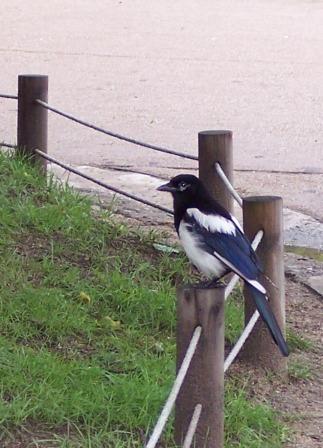
| The magpie is a noisy bird! |
![]() |
| One of the grand halls at Gyeongbukgoong |
![]() |
| Pavilion at one of the ponds |
![]() |
| The famous Gwanghwamun |
Subscribe to:
Posts (Atom)