Friday, April 30, 2010

The New Yorker: "La Vita Nuova" by Allegra Goodman


Amanda is an artist who teaches at a pre-school in Cambridge. She gets dumped by her fiancé shortly before the wedding. She understands that she loved him but he, obviously, didn’t love her. She is let go by the school—her grief over the engagement spills into her work—and gets a summer job taking care of one of the students. In the boy’s father’s home she finds a copy of Dante’s La Vita Nuova, in which she learns that a man in love should weep. She remembers that her fiancé said she made him laugh, but “Love weeps,” Dante wrote.
At the end of the summer, she’s rediscovered her art. She learns that her charge’s father wants her to sleep with him, but it’s only the little boy who weeps. And she understands, apparently, that his love is real.
I like it. Amanda seems very real. Her reaction to the broken engagement seems real. The fun things she does with the little boy seem real. The way memories of her fiancé keep popping into her head seems real. And over the course of the story, she gets over him.
It doesn’t strike me as a terribly deep story, but it’s nice. I liked it.
May 3, 2010: “La Vita Nuova” by Allegra Goodman

Thursday, April 29, 2010

List List

 That's "List" as in a series of names or other items and "List" as in an area of combat (especially jousting tournaments). There's been a controversy over the last couple of days over the appearance of a new litmag ranking. See, if you're interested, the Faster Times' Literary Magazine Ranking. If you do go there, you'll see that the creator generously nodded in the direction of my own ranking, which has been around for five years now: the Perpetual Folly Pushcart Prize Ranking. He then goes on to explain his own system for the rankings that follow, which are divided into tiers. (My rankings don't include the slicks, but if I were to go subjective and put those magazines on the list, I'd put Atlantic and probably Playboy up there with New Yorker and Harper's. These are mega-credits, and very desirable.)

Some people, though, aren't thrilled with what Faster Times has done. Scott Garson, for example, explains his "contempt" here. But then Scott also admits he doesn't "love" my ranking either.

Here's the problem with lists. They're incomplete. My list, for example, only deals with magazines that have won a Pushcart Prize or Special Mention in the last decade. Which means that there are hundreds of magazines not on the list because, for better or worse, Pushcart doesn't capture a lot of online magazines. Hardly any, in fact. So there are some fine online magazines that aren't on my list. It's hard to be sure that a print magazine that has earned one point on my list--and so is tied for last place--is better than an online magazine that hasn't yet been recognized by the Pushcart folks. So my list is far from perfect. It's a tool, that's all. I don't yet have a tool to help me with online magazine submissions -- so far I just submit to the places I like. Probably that's not a bad approach.

Wednesday, April 28, 2010

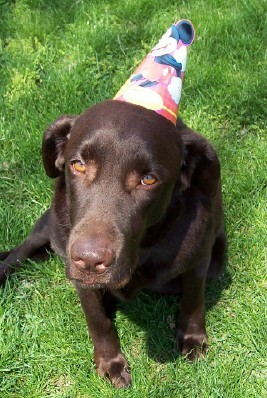
Happy Birthday Bhikku!

Today is Bhikku's 8th Birthday! And it's also exactly two weeks since the gall bladder surgery that saved his life. (For background, see here and here.) He's doing very well in recovery, and has gone off his pain meds and is down to just one antibiotic. He gets his staples out tomorrow and he'll have a blood test and liver panel that I'm confident will show another drop in his bilirubin levels (his eyes get less yellow each day). Yesterday, after he'd been off the Tramadol for a day, he insisted on going for a walk, so we did. That's a really good sign, I think. (The picture is an old one . . . from his 5th birthday, I think.)

Saturday, April 24, 2010

The New Yorker: "Edgemont Drive" by E.L. Doctorow

Dialogue flood. This story, which otherwise has a conventional arc—and maybe that’s the reason Doctorow made this choice, in order to freshen it up—is all dialogue. No exposition, no narrative, not even dialogue tags. All dialogue, without a quotation mark in sight. (If ever there was a situation where quotation marks would get in the way, this would be it—the story would be littered with them.)

Husband finds out that Wife has noticed a man in an old car parked across the street. He’s a traditional guy and is partly jealous and partly protective of his wife. Later, he has a chance to confront the man in the car and he learns that the man used to live in their house. Husband isn’t impressed, but Wife, while Husband is at work, invites the man in and learns his life story—a poet and teacher, divorced, quit his job, has an adult daughter, is driving around the country. Husband still isn’t impressed and is upset with his wife for inviting the guy in. Husband has a point, but he’s being a jerk about it.

But they make up, apologize, and it starts over again. Eventually, the man in the car is arrested and has no one to call but the Wife, who—inevitably—invites him to stay while the police are examining his car. And then . . . but, no, you can read that for yourself.

So what’s it about? The key, it seems to me, is buried in the conversation Wife has with the old man. She doesn’t really get it, but he says: “It’s much like I suppose what a chronic invalid feels, or someone on the verge of dying, where the estrangement is protective, a way of abating the sense of the loss, the regret, and the desire to live is no longer important.” And the Wife, we sense, is also on the verge—not of dying, but of changing, of breaking out of the suburban bubble. She’s not happy—the man can see this, and the reader senses it—and her estrangement is protective.

While the ending feels neat and resolved, we understand that in reality nothing is resolved.

April 26, 2010: “Edgemont Drive” by E.L. Doctorow

Friday, April 23, 2010

New Issue: Waccamaw

There's a new issue of Waccamaw up, with fiction by Ethel Rohan, Edmund Sandoval, and others, poems, essays, and an interview with Padgett Powell.

Wednesday, April 21, 2010

Bhikku update

Bhikku is doing pretty well, considering what he's been through. (See Pet Worries.) He's made steady progress and his appetite has been good ever since he got home. (He's not completely regular in some of his other . . . habits . . . but the vet isn't too worried about that yet, so neither am I. She prescribed yogurt.)

On Tuesday we went in to the local vet's office for blood work, which revealed that his bilirubin levels have come down further (originally "off the charts"--over 35--they had fallen to 16 after surgery and 6 on the day he was released), but still aren't at normal levels. His eyes and skin are sill a little yellow, but nothing like they were. And he just seems happier; he certainly enjoyed all the attention he got from the vet and the technicians, who called him their "miracle dog"--reinforcing for me just how close he came to dying.

The bland diet continues, along with a host of pills -- antiobiotics, pain meds, antacids. We did learn that the biopsy was negative, so that's good, and we're using the right antiobiotics to fight the liver infection, so that's good, too. Soon he can start going back gradually to his regular food (if he will -- he might insist on white chicken meat from now on), and next week we'll do the blood tests again AND get the staples removed. (I hope no one invites me to watch while that's done.)

Atlantic Surprise

Remember when The Atlantic Monthly dumped their monthly fiction in favor of an annual summer fiction issue? And remember that the fiction issue was sold separately, only on the newsstand, not part of a subscription? I do, and as a fan of the fiction in the magazine, and the great fiction editor C. Michael Curtis, this pissed me off. I often found the rest of the magazine to be terrific, but my favorite part had been the fiction. So for some time I've been considering dropping my subscription . . .

Good thing I didn't. Today, the new issue arrived and it included a "supplement to The Atlantic" -- the 2010 Fiction issue! The issue includes stories by T. C. Boyle, Amanda Briggs, Jerome Charyn, and others, and essays by Richard Bausch and Joyce Carol Oates. Plus poetry, an interview, and short reviews. It looks great.

Whether the supplement will be available for purchase separately I don't know, but in any case it appears to be available online: Atlantic Fiction 2010.

Tuesday, April 20, 2010

The New Yorker: "Prefiguration of Lalo Cura" by Roberto Bolaño


The narrator is Lalo Cura, the son of a woman who acted in porn films in Colombia even while she was pregnant with him. He claims to have been able to see the men who had sex with his mother and now he has come to speak with one of them, Pajarito. Pajarito thinks Lalo has come to kill him, because apparently that’s what Lalo does. But no, he only wants to talk.
The narrator, it seems, sees the porn industry in Latin America as a metaphor for the condition of the continent. The men are all either diseased or dead of violent causes, and the women are, for want of other options, whores. This may or may not also be Bolaño’s view, but Lalosurely feels this way. And yet Pajarito is his only link to the only innocent time of his life.
Not much of a plot here, but the language of the story is intoxicating.

April 19, 2010: “Prefiguration of Lalo Cura” by Roberto Bolaño

Sunday, April 18, 2010

The Los Angeles Review: divergent, West Coast literature

One thing I was able to do at AWP was to pick up my contributor copy of the new The Los Angeles Review: divergent, West Coast literature  which includes my story (from the Oliver series), "Justice, Inc."

It's a great looking magazine that includes fiction by Rick Bass, Ben Percy, Pamela Painter and many others (including friends Aaron Burch, Ann Hillesland, Beth Thomas, and Bonnie Zobell); non-fiction by Barry Lopez (and many others, including friend Hobie Anthony); lots of poety; and interviews with, among others, Michael Czyzniejewski.

It's a bargain, too. You should buy it!

Friday, April 16, 2010

Pet Worries

This could be considered a sequel to my AWP Reports, I suppose. I got home from Denver on Sunday afternoon. On Monday morning I picked up Bhikku from the kennel. The folks at the kennel know Bhikku well and they reported, worriedly, that he'd been vomiting and had dark urine. The dark urine was especially troubling and I also observed that when we got home. Nonetheless, I fed him -- and later in the evening he threw up. I also noticed that his eyes were jaundiced.

So first thing Tuesday I took him to the vet. They did some tests and took xrays, and while the pictures were inconclusive the blood work showed that his levels of bilirubin were extremely, and worryingly, high. They watched him for a while and then called to recommend that I rush him to a critical care vet clinic down in Richmond (VRCC), 90 miles away. That got me worried, of course. I bundled him into my Jeep and away we went at about 3:30. He was nearly comatose, and those yellow eyes were scary. He coughed every so often and when I didn't hear anything for a few miles--he was in the "way back" so I couldn't see him--I feared the worst.

But we got to the clinic at 5pm and after I lifted Bhikku out of the Jeep he walked in, sniffed around, and was led back to the working part of the office where they began to attend to him. It was nearly 8pm when I finally got to speak with a Doctor, who explained what she thought the possibilities were. I'd been fine up to that point, but my exhaustion, my cold, and the reality of what was happening got to me finally, and I could barely speak. But I approved an ultrasound and then returned to the waiting room.

At some point after 9pm, the Doctor showed me the results of the ultrasound, which weren't conclusive. She recommended surgery, to occur the next day, and I agreed, even though I knew it wasn't a guaranty of survival. I went back into the kennel area and sat with Bhikku for a while, knowing it might be the last time I saw him alive. The drive home -- in the rain -- was no fun.

The next morning I got a report before and after the surgery. I learned that a gallstone had been removed, as well as the gall bladder. I was relieved about the stone, because that clearly was what was causing the symptoms we observed, and its removal was important. There were still tests to be run on the gall bladder and liver, but I considered the stone to be good news. That was Wednesday. Each time I called -- Wednesday night, Thursday morning and night -- the reports were good: he was eating, the bilirubin levels were falling, he was a sweet dog. This morning when I called I learned that he would be discharged today.

So back to Richmond I went, in a far better mood than I'd been in on Tuesday. There was some paperwork to do, the bill to pay, and discharge instructions to review. They handed me a bag of medicine bottles -- pain relievers, antibiotics, etc.-- and another bottle that contained what looked to be a nut: it was the gallstone they'd removed, about the size of a chickpea. Swell. A souvenir. Finally Bhikku was brought out. He was obviously woozy, but way better than he'd been the last time I saw him, and seemed happy to be taken out to the Jeep for the trip home.

He's sleeping now. He's had one bland meal and more meds, and we'll get test results over the next week or so that could curb my optimism, but for now I'm very happy that he's home.

Thursday, April 15, 2010

The Book of Fathers by Miklós Vámos


The Book of Fathers

Miklós Vámos

Other Press 2009

 
While the point of this sprawling novel eludes me — is it that we should never forget the horrors of the past? — I can't help but be impressed by its scope. The story begins in 1705 with the first entry in The Book of Fathers, a journal passed from father to son through eleven generations of a Hungarian family: "The Lord be praised, we reached the village of Kos in the month of April in His Year of 1705. Five times in that year and in the year thereafter was the village laid waste, thrice by the Kurucz bands of the insurrectio Rákócziensis, twice by the Labancz troops of the Emperor." And so begins the saga, as young Kornél Csillag survives the various attackers, remembers what he cannot possibly have scene, and passes along extraordinary gifts to generation after generation. Some of Csillag's heirs can see into the past, recalling what their ancestors have experienced; others can see into the future to what they themselves will experience. Some have profound abilities to learn music or languages known to their predecessors.

The family name morphs over time, from Csillag ("Star" in Hungarian or Magyar), to Sternovszky, to Stern ("Star" in German), and back. And over time the family suffers the oppression and anti-semitism of the Hapsburg Empire and then the Nazis and their collaborators, and then the Communists. The Csillags are winemakers, glassmakers, shoe salesmen, scholars, singers, gamblers. Some of the family members are successful in business, some in music or letters. But through it all, The Book of Fathers passes from hand to hand, from father to eldest son. A second volume is created and then a third, and then the latest generation puts a file on his computer in which he carries on the tradition.


As the story approaches the present through Henryk Csillag-Stern, raised in New York but now back in Hungary where he feels more comfortable, the horrors of the past seem to have receded (although Henryk's father has been killed by urban thugs, not unlike the marauding bands of 1705). His son, Konrád, is blessed: "At a year and a half, he was able to recall and recite stories he had heard, word for word. Poems heard a few times also came out exactly as the originals, and again and again." The boy solves puzzles with ease and draws, even using the computer. When asked how he knows how to do this, he says it's because Henryk knows. He has the memory of the old times, and draws from that. And then, when he is four, he creates a Book of Fathers. On the occasion of a solar eclipse, harkening back to an eclipse hundreds of years earlier seen by Kornél Csillag, Konrád "sees" in his mind what Kornél saw: "CAVE WATCH BEGINNING."


And so what to make of all this? What are we to make of the thread of astrology mixed with the predictions of Nostradamus? What of the circularity, with Henryk and Konrád returning to the beginning of the book, both the place and the eclipse? And what does this portend for Konrád, whose gifts seem as strong as any in the Book of Fathers, which now appears as though it will continue. Henryk has done some research into the family tree, getting it mostly wrong, but Konrád, it seems clear, knows the answers. He knows what the family has been through, and he knows that he holds the key. What of these odd powers that the oldest sons have?


The saga is an impressive achievement, despite these unanswered questions, and well worth reading.

Wednesday, April 14, 2010

Beyond the Underground

As a recovered lawyer, I found this blog interesting:

Beyond the Underground

Announcing: Prime Number Magazine

I'm very excited to announce the coming of Prime Number Magazine, the first issue of which will debut on July 19, 2010. The magazine, which will be an online quarterly with a print annual, will feature distinctive prose and poetry, including short stories, creative non-fiction, poems, reviews, interviews, and more.

The magazine is a publication of Press 53. I am the editor. Val Nieman is the poetry editor.

Sign up for the mailing list now on the website, or become our fan on Facebook, or follow us on Twitter, and you could win over $250 worth of books from Press 53. (We will open for submissions after the first issue appears. Stay tuned for details.)

AWP Report - Part 3

The last day of the AWP conference was another busy one. I started with a 9AM panel: "Telling Other People's Stories: Narrative Nonfiction, its Pleasures and Perils." Five non-fiction writers talked about their projects and the challenges of finding the right subject and then getting close enough, or too close, to investigate.

Next I went to "Private Practice: Managing the Novel from Symptoms Through Recovery" moderated by my friend Elizabeth Brundage and featuring novelists Jennifer Haigh, Michelle Richmond, Meg Waite Clayton, and Richard Bausch. I can't say I learned anything new, but there were some useful reminders about discipline and process, and it's always amusing to hear Bausch's stories, even the ones you've heard before.

I'd made arrangements to meet someone to talk about a panel proposal for next year, so I went back for a last pass through the bookfair. We met over lunch (expensive, bad food in the onsite cafe) and then at 3PM I went to my last panel: "What to say and when to say it: Disclosure of Information for Optimal Effect in Fiction." This was one of those panels where everyone reads a paper on the topic, and that worked well here. Robert Boswell talked about the difference between information in the surface narrative and withholding information in the underlying narrative, using as his example the story "Yurt" by Sarah Shun-lien Bynum (which I discussed when it came out in The New Yorker in 2008 here: Yurt). Lan Samantha Chang talked about The Great Gatsby (in which Gatsby's backstory is revealed in pieces throughout). C.J. Hribal and Peter Turchi also were on the panel.

After that we wrapped up the Press 53 table in the bookfair, got dinner (I also attended the reception for Image Magazine) and then went to the ballroom to hear Terry Tempest Williams and Rick Bass. Good stuff, but I had to call it a night in order to pack and make it to bed before my 2:45AM wake-up call, to make the early shuttle to the airport. (Too early, as it turned out, as United won't let you check in until 4:30, so we stood around for almost half an hour.)

Tuesday, April 13, 2010

AWP Report - Part 2

The second full day of the AWP Conference was busy. The first panel I went to was "Writing the Mind's Wild Geography" moderated by Hannah Fries of Orion Magazine. The speakers all addressed how a sense of place can be both physical and metaphysical. I was especially drawn to Ann Pancake's comment that in a novel one can explore the impact of place on the interior of our characters in a way that non-fiction cannot. (Although in a panel I attended later on writing other people's stories it was argued that creative non-fiction can also do this.)

I then went to a panel on "The Future of the Book" in which Mary Gannon of Poets & Writers, Dennis Johnson of Melville House, Lee Montgomery of Tin House, and agent Julie Barer talked about changes that have occurred in publishing. No one had anything nice to say about Amazon or Barnes & Noble.

I spent a lot of time on Friday at the Bookfair, including a stint at the Press 53 table signing my book. I also wandered the aisles handing out our postcard announcement of I also wandered the aisles handing out our postcard announcement of Prime Number Magazine.

Soon it was time to head down to the Post Road party at a bar on the 16th Street pedestrian mall, which I had to leave early to go to the Queens MFA party a block away. When that broke up I headed over to the Sewanee Writers' Conference party in the hotel. It was great to see old friends at all three events.

Lots of folks then went to the George Saunders reading, but I wanted to support some friends who were reading at the Denver Press Club in a benefit for WILLA: Women in Letters and Literary Arts. I'm not sure I really support the aims of the organization -- the days of women being excluded from the book industry are gone, in my view, despite the controversy over the Publishers Weekly male-dominated top-ten list for 2009 -- and I thought the burlesque entertainment between readers was inappropriate ("you missed the point," I'm sure someone will say, as if there could be a feminist point to women stripping down to g-strings and pasties). The readers (so many that they only got 3 minutes each) seemed to be having fun, though, and the room was crowded.

Monday, April 12, 2010

AWP Report - Part 1

Last Wednesday was a beautiful day for flying. Hot and clear here in the East, cool and clear in the West. I boarded a puddle-jumper at our little local airport and, after a short layover, settled into the Airbus for the trip to Denver. We arrived a little early, my luggage didn't get lost, I found the Super Shuttle kiosk, and made it the Hyatt by about 1pm.

Later in the day, after I got checked in at the hotel and the conference, I helped Kevin of Press 53 set up the bookfair table, and then we took advantage of free WiFi at the Barnes & Noble to catch up on emails, Facebook, Twitter, etc. Then we connected with Mary Akers, and all went out to a nice dinner to toast the beginning of the conference.

Back at the hotel, Kevin and I attended a reception in honor of bookfair exhibitors, but we were both exhausted--and still on Eastern Time--so we called it quits early.

Thursday was the first full day of the conference. Kevin headed to the Press 53 table and I went off to a 9AM panel. The panel I chose was "The In Sound from Way Out: Submission to Publication" which promised that the editors of several magazines would "unpack their editorial projects and processes"--just what I needed as we embark on the Prime Number Magazine adventure. It was interesting to hear their different approaches to what are essentially the same jobs.

I skipped the 10:30 panel because I was anxious to make my first pass at the bookfair, which is a tremendous part of AWP. I walked past 500 tables/booths, and then managed to get to a 1:00PM panel on "How to Start Your Own Online Literary Magazine" which in the end wasn't really that at all, but still it was interesting to hear how some really good online magazines began and operate. The 3:00 panel I chose was similar and dealt with handling the slush pile, although the editors on the panel adjusted the discussion somewhat being under the impression that the audience was made up mostly of writers rather than editors. I wish they'd stuck with giving advice to editors, but it was still interesting.

Back to the bookfair; I skipped the last panel of the day; and then I went to the bar to hookup with a bunch of online literary friends. We had a few drinks there and then made it to the Mercury Cafe just in time to eat elk burgers and listen to readings: Vermin on the [Rocky] Mount. After that we checked out a private party in a hotel room -- which was promptly shut down by hotel security. Fun while it lasted!

Stay tuned for Part 2.

2010 Pulitzer Prize winners in letters and drama / The Christian Science Monitor - CSMonitor.com

Tinkers by Paul Harding wins the Pulitzer for fiction:
2010 Pulitzer Prize winners in letters and drama / The Christian Science Monitor - CSMonitor.com

Tuesday, April 06, 2010

AWP- 2010 Conference

I leave early Wednesday for Denver: AWP- 2010 Conference. If you're a writer and haven't been to one of these events, set your sights on DC in 2011, Chicago in 2012, or Boston in 2013. This will be my fourth in row (Atlanta, New York, Chicago, and now Denver) after missing opportunities to attend the Vancouver and Austin conferences in earlier years. About 5,000 writers attend -- New York was overwhelming, with something like 7,000 -- and there are panels on just about every subject imaginable pertaining to writing and the teaching of writing. In addition, though, there are parties and other networking opportunities. And the best thing of all is the bookfair.

This year I'll be hanging around some at the Press 53 table, where signed copies of my book will be available: In an Uncharted Country.

And I plan to do some blogging and tweeting from the conference -- if I can find the time.

Kind Words for In an Uncharted Country


 The April issue of The Short Review includes a very thoughtful review of In an Uncharted Country. There's also an interview with yours truly.

The issue also includes reviews of books by Peter Orner, David Eagleman, John Cheever, Bonnie Jo Campbell, Ian Daley, Mary Gaitskill, Kathryn Ma, David Constantine, and Paolo Bacigalupi.

College Hill Review

Here's the latest issue of the College Hill Review, a double issue in honor of the late Richard Poirier.

Monday, April 05, 2010

The New Yorker: "The TV" by Ben Loory


Huh? So the man (who has no name, which means he’s “everyman” I suppose) plays hooky from work and watches TV, but realizes that he’s watching himself. When he returns to work, he sees that his TV self has done more work than his real self usually does. And it turns out on other channels his other self is a surgeon, an undercover agent, etc. Eventually “the man” decides to stop watching TV and throw it away, but on his way down stairs he runs into himself bringing the TV back, and those two run into another and . . . it’s like looking into a mirror with a mirror. There are too many of him to keep track of. He’s not going to work, he sobs uncontrollably, and he’s got the TV plug in his hand. Huh?
This story reminds me of The Knocking from a few weeks ago—the language is interesting, the twists are compelling, but what’s it all mean? Are we meant to think that some of what “the man” is watching on screen is real? Or that some of it represents his ambition? Or fantasy? Did he really want to be a surgeon? Does he dream of closing big deals? Did he lose his wife? Is he sobbing uncontrollably because he’s stuck in his dead-end job with no way out except his fantasies?
Perhaps. Comments?
April 12, 2010: “The TV” by Ben Loory

Sunday, April 04, 2010

Andrew’s Book Club -- April Picks

Andrew’s Book Club

This month, Andrew picks two small press books: Becky Hagenston's Strange Weather, out from Press 53. The book won the Spokane Prize for Short Fiction but the press folded, so it's wonderful for everyone concerned that Press 53 was able to step in. And Matthew Pitt's Attention Please Now, from Autumn House Press. There's one "big house" pick this month, too: Robin Black's If I Loved You, I Would Tell You, from Random House.

ASC: The Roman Actor

The Actors' Renaissance Season draws to a close today with the matinee performance of Twelfth Night, which I've seen twice and highly recommend.

But last night I saw ASC perform The Roman Actor by Phillip Massinger, a play I had never seen before and knew nothing about. While the plot of the play isn't terribly complicated, it is filled with important ideas about despotism and power, and also about the roles we play. The despotic emperor takes a wife, never mind that she's already married--Caesar decrees a divorce and, for good measure, has the husband killed. But she's a hungry sort, and casts her eye on Paris, a tragedian who would like to remain loyal to Caesar, but is now in an awkward spot. Caesar takes care of that problem, but eventually the people get fed up with his despotism.

The company had very little time to stage this show and only did a few performances of it (last night was the closing), but did an amazing job in any case. As the power-mad Caesar, John Harrell was wonderful, as was Denice Burbach who played Domitia, his wife. She was especially fun when drooling over Gregory Jon Phelps's Paris, the actor who gets caught in the middle. Phelps was excellent, too, and several of Paris's speeches carry the weight of this play. (I need to read this play now, to catch the full impact.) Benjamin Curns was terrific as Caesar's "freeman" Parthenius, who eventually joins the rebellion. The rest of the cast did a fine job, too: Miriam Donald, Allison Glenzer, and Sarah Fallon as women abused by Caesar who are jealous of Domitia; Tyler Moss as Domitia's husband and later as Stephanos, the servant who joins the rebellion; Rene Thornton, Jr. and Daniel Kennedy as Senators who speak out against Caesar's tyranny and pay for that with their lives; and Chris Johnston as Aretinus, Caesar's spy.

I'm sorry to see the Renaissance season end, but I'm looking forward to the shows that the touring company will be presenting at the Blackfriars over the next few months: Romeo and Juliet, All's Well That Ends Well, and The Knight of the Burning Pestle.

Bound Off

Bound Off today has a special edition, celebrating the life of poet Robert Dana.

Friday, April 02, 2010

Thursday, April 01, 2010

The New Yorker: "Gavin Highly" by Janet Frame


Here’s another story from New Zealander Janet Frame, who died in 2004. In this one, Gavin Highly is the town oddity, a guy who is said to have lived in a rabbit burrow and invited ferrets to tea. But now he’s in a house that’s about to be condemned and in order to raise money to buy a proper house, he’s going to sell his books, which Highly says are worth a lot. “Gavin Highly collected and loved books. No one had every really seen these books, but hearsay had it that they were worth thousands of pounds . . .” So when things don’t work out quite the way he’d hoped, the people speculate about what will happen to Highly, until that question is finally answered.
Two things stand out. First, there’s the language of the story, which on first reading is obscure, as in this passage: “I did not know back then that hearts could be laid out like land and cut in two by storms coming out of the sky, or that dreams could be thrown, as Gavin Highly threw the ashes of his fire or his oyster shells or his old tins and bottles or his scraps of food, deep into the dark flowing divided heart to be buried there.”
And second, the narrative voice is of a child who observes the subject and is, in a sense, the subject, as many observer narrators are. In this case, the child and a brother take plums from Highly’s trees, but are not harassed by the man. (“I think he understood about plums.”) When Highly is down on his luck, they take him bread and treacle. And they listen with sadness to the news about the man’s desperate situation. The point of view is retrospective, and the reader understands that Gavin Highly has had a deep impact on the narrator.
I enjoyed this. It didn’t knock my socks off, but it’s a nice story. 
 April 5, 2010: “Gavin Highly” by Janet Frame

ASC - No Kidding Shakespeare Camp for Adults

A week of Shakespeare camp this summer? What an awesome idea! I think I'd pass on the dorm living, but I'm seriously considering signing up for this!

ASC - No Kidding Shakespeare Camp for Adults